

“What changed?”
A person asks in ordinary language.
The product experience
Agent Army brings specialized AI workflows and governed analytics to retail-supplier operations. Here is a more tangible way to understand the experience, not just read about it.
Four ways to put intelligence to work
Ask, investigate, share the business context and explain what deserves attention; with your team keeping the judgment. These public demo screenshots make the interface tangible. The story and agent examples are labeled workflow illustrations, not customer deployments.
Select a view below to explore the experience. View 1 of 4
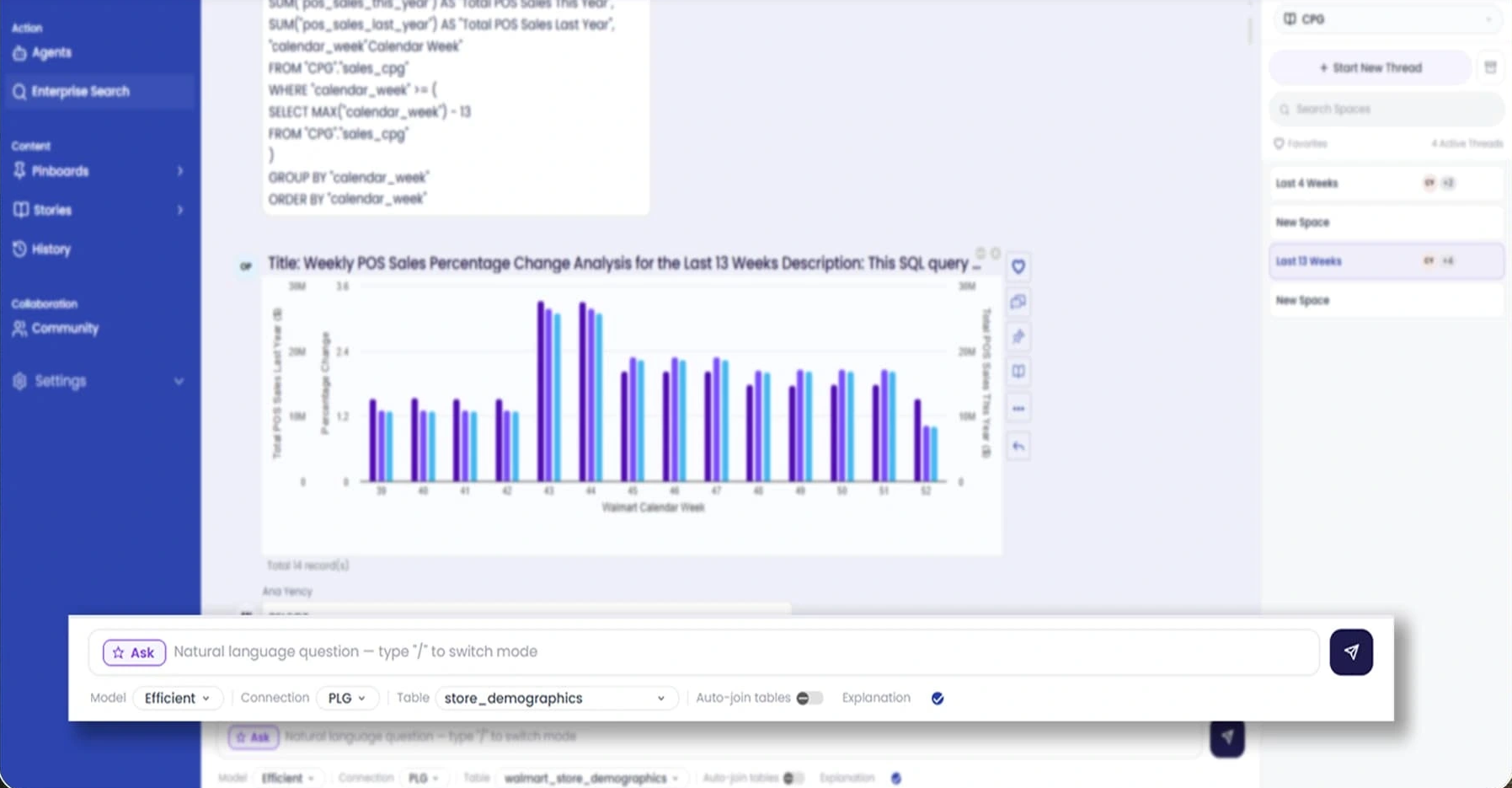
Ask in business language, investigate the context and examine what supports the answer.
Public demo screenshot · cropped for this review. Not a customer deployment. Branding and capabilities are confirmed for each implementation.Under the experience: business meaning
Agent Army applies retail definitions and operating context to governed analysis and scoped specialist workflows. Define the meaning before delegating the task.
A person asks in ordinary language.
The semantic layer maps terms and rules.
Analysis follows the agreed scope.
A person evaluates context and next steps.
A semantic layer is the shared dictionary of business terms, mappings and rules. It helps a question about “sales” mean the same thing across the workflow. Actual data flows and controls depend on the sources and deployment.
What the AI component brings
Natural-language analysis, defined business meaning, recurring checks and source-backed outputs support different parts of the supplier’s job.
Move from a business question to governed analysis instead of starting with a fresh SQL request.
Use defined business meaning and the relevant source data or documents to examine a question.
Configure recurring checks and exception workflows around the signals your team wants reviewed.
Keep sources, definitions and review context close enough for people to challenge and validate the work.
These describe Agent Army role areas and workflow capabilities to assess. Actual capabilities, permitted sources and outputs depend on the scoped implementation, not a universal feature entitlement.
Specialists with a job to do
 Synthesis & analysis
Executive synthesis, prioritization and decision support. Turn context into a clearer brief for a person to review.
 Monitoring & exceptions
Anomaly detection, KPI monitoring and alerts, configured around human-defined signals and review rules.
 Investigation & preparation
Deduction and chargeback support, document extraction and evidence preparation for the people who own the decision.
Source-defined role areas to scope, not identical out-of-the-box features. Inputs, integrations, review boundaries and sellable implementation scope are confirmed in the Mission Brief.
From concept to actual software
A real product walkthrough should show the question, the result, the source trail and the review experience. We will match the demonstration to the mission being evaluated.
The first two views show a public demonstration interface. The story and agent examples are illustrations. A guided demo should validate the actual screens, source context and capabilities relevant to your mission.
See it. Question it. Find the fit.
See how the AI experience could fit a workflow your team already owns. Start with a demo, not a commitment to replace your tools or your people.